
Log in to save to favorites
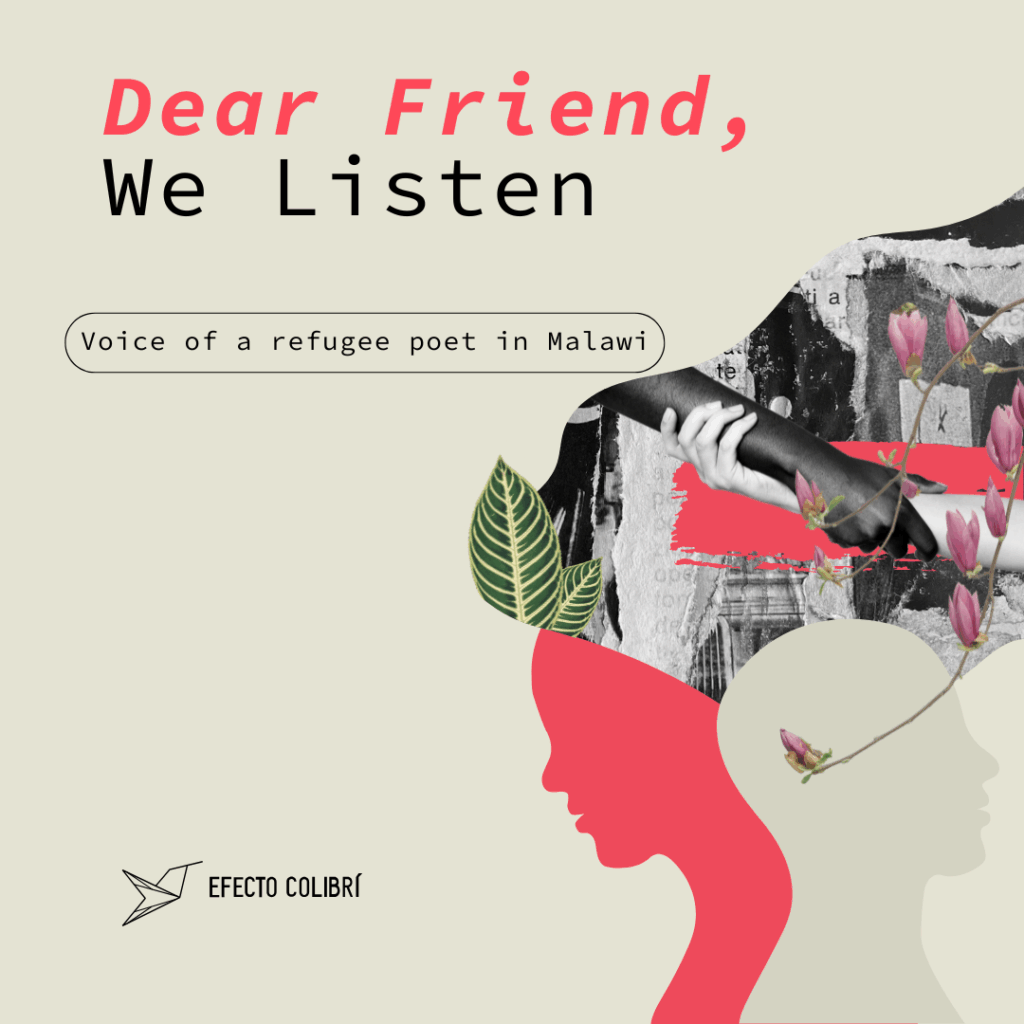
In this episode, Ana Amrein Esnaola opens the mic to Espoir Kahitani—a young poet born in the DR Congo and raised in Dzaleka refugee camp, Malawi.
“Refugee is a label, not my name,” he says.
He revisits a childhood of charcoal stoves and night songs, the attack that changed everything, and the discovery of poetry as a practice of hope.
Listening is social innovation. It reveals what must change and helps move stories toward a just, diverse, and regenerative reality.
01:10 — “Refugee is a label, not my name.”
04:50 — Childhood: smoke, drums, and silences
06:30 — The night it changed + flight to Dzaleka
12:10 — English, The Branches, and finding his voice
19:40 — Weariness, faith, and hope in action
Special thanks to Home Storytellers for the connection. Learn more about them here.
Follow us at https://efectocolibri.com/en/ and rate us ⭐⭐⭐⭐⭐ so more people can find this content.
We use cookies to improve your experience and offer you personalized content. By accepting, you help us provide you with a better service.

únete a nuestro newsletter
Dedica solo 5 minutos para contarnos cómo te impacta nuestro contenido.
[voice: Ana Amrein Esnaola, founder of Efecto Colibrí]
I hope you are well. I’m Ana, from Efecto Colibrí, and I’m glad to bring you a new episode of “Dear Friend, We Listen”—a mini-series of single chapters where stories pushed to the margins return to the center. [pause]
For us, listening is social innovation. It lights up the problems we aim to transform and helps move narratives toward a just, diverse, and regenerative reality. [pause]
Today we open the space to Espoir—yes, hope—a young poet and storyteller born in the Democratic Republic of Congo and raised for years in the Dzaleka refugee camp in Malawi. [pause]
Espoir reminds us that “refugee” is a label the world uses, but it is not a name. It does not hold a person’s dreams, past, or potential. [pause]
Between loss and reunion, he found language and poetry. Pain became word, word became bridge, and bridge points to the future. Perhaps this is the quiet revolution: when and where you least expect it, there is the most hope, the deepest motivation, the fiercest will. [pause]
Stay with us. This episode is not about what was taken from him, but about what Espoir chooses to create—life named by hope. [pause]
What does the word “refugee” mean to me, and why? I do not identify with that word. To the world, it is a label and a way to categorize. For me, it is not my name. It does not hold my dreams, my past, or my potential.
I do not wake up feeling like a refugee. Instead, I wake up as Espoir—a poet and a storyteller. I am a human being who has lived through storms and still sings.
“Refugee” looks backward. I am going forward. I carry hope and the voices of many, not a faceless identity.
My name is Espoir Kahitani. It is a French name. In English, it means “hope.”
I am 19 years old. I was born on 3 February 2006 in the Democratic Republic of Congo. I am Congolese by nationality. When I say “Congo,” I feel pain now. The love I had has almost gone.
My childhood was short. It felt stolen. We ate ugali almost every day. Sometimes we had beans. Sometimes cassava.
I remember the smell of smoke from open fires. My mother cooked with charcoal. She mixed whatever we had. There was never enough.
Despite the smoke, my siblings and I gathered around the fire. We warmed our hands. We told stories—fairy tales and scary ones.
In the morning, I smelled wood burning. I heard my grandmother sweeping the yard. Sometimes cassava fried in the pan. Sometimes beans simmered in a dark pot, black from years of use.
I walked barefoot on red dust. I felt the earth’s roughness. I had slippers, but we loved walking that way. It was our game.
Tall trees lined the road to school. When the wind was kind, it brushed my face.
Music thumped from the barbershops as I climbed the hill. It lifted my mood before class.
I heard water splash at the community tap. It sounded like life itself.
At night, people laughed under the moon. Drums and songs carried history, pain, and pride.
Yet other sounds cut through: gunshots slicing silence, people screaming, mothers crying. Then came the loudest sound—the silence after something terrible.
Music still stayed with me. It whispered to the past. It reminded me I am more than what I survived.
We lived in a small rural house. At times I slept on the floor near my youngest sister. Distant gunfire, crying, and silence became daily background noise.
I once wrote a poem: “From the ka-ka-ka—the sound of guns—to the ka-ka-ka—our lives sit down.” Many refugees know that poem.
I was born in Sange, in South Kivu. Peace was rare. People did not sleep with one eye open. They lived that way.
Gunshots were normal. You woke up to learn a neighbor, a classmate, or a friend did not make it through the night. Faces gathered. Bodies were buried. Life still went on.
My father is Kabera Kahitani. My mother is Leah Mwabi. My grandmother on my father’s side is Tabu Mawazo. My aunt is Nyota Vumilia.
Here is why we are in Dzaleka Refugee Camp.
My aunt married into another tribe. After her husband died of sickness, his family turned on her. They blamed our side of the family.
Threats followed. They accused my grandparents and my parents. They accused all of us.
One night, they attacked. They came for blood. They took my grandfather. Days later we heard he was dead. We never saw his body.
That night they beat my grandmother. She lost vision in one eye. I hid under the bed. I heard her cries.
In the morning, I woke up in a hospital. I did not know how we got there. Everything had changed.
My grandmother and I ran. We did not know where the rest of the family had gone. We did not know if they were alive.
We crossed borders with fear and faith. Good Samaritans helped us on the way.
We reached Malawi—Dzaleka Refugee Camp. I reunited with my aunt and her family. Later, my parents arrived. It felt like a broken puzzle finding its pieces again.
I did not like the fear or the running. I felt disappointed. The “better place” was not better.
Dzaleka is crowded. When it rains, roofs leak. I look up my house on Google Maps and see almost nothing. Everyone struggles. Trauma is everywhere.
I do not like waiting. We wait for resettlement and for answers. I have lived in Dzaleka since 2014—eleven years. I feel forgotten by UNHCR. The process does not move.
Friends arrive. Then they leave. Canada. Australia. Other places.
My friend Salvador Kabi was my poetry partner. We learned together. He left too. We still talk, but I miss his presence. The trauma grows.
If someone came to free me from this bondage, I would call him my Moses. He would pull me from Pharaoh’s hands.
I am waiting for my Moses and his lullabies. I wrote a poem about it yesterday.
I asked God to send me a Moses to lead me from this Egypt. I want to see the light. I want refugees like me to see the light and become who we are.
I am trying to be great. I am not yet who I am supposed to be. I see a different person in the mirror. I imagine a different future.
I will do great things. Still, I need a way out. That is the reality.
Pain, escape, and reunion are etched into my story. I am a survivor. I am a human being with a voice. This podcast is that voice.
I came from zero. My journey was tough. It gave me experience and strength.
I arrived in Dzaleka without English. I could not count. Language was my barrier.
I studied at the White Future Center. With steady practice, I earned an English certificate in six months.
Then I discovered poetry. It became my strongest way to speak.
After graduating in 2018, I entered a poetry competition. I was eliminated in the first round. It hurt. Yet it lit a fire.
I looked up the poets who beat me. Many belonged to an arts club called The Branches.
I reached out and met their president, John Kazadi. He welcomed me.
Through performances and talent shows, I sharpened my craft. I began to win. I found my voice and confidence.
Eventually, I stepped out—not to cut ties, but to see if I could stand alone. I still visited The Branches. I also served the community. I taught young poets to write, memorize, and speak.
I am tired of writing poems about refugees. The name does not leave. In the mirror, my heart runs fast. It fears being last in a world that forgets the last.
My heartbeat races in clean places and in dust. I do not fear death. Nothing lasts forever.
I wake from a dream, and I am still in the camp. My heart is sad. Where is she—the one I spoke with yesterday? Where is he—the man I saw this morning?
The same day, they are resettled to the USA. Tears fill my eyes. Are they joy or sorrow? I will miss them. I will kiss their pictures. I ask God, “Where is she? Where is he?” I fear I will ask, “Where am I?”
Am I dreaming or alive? Touch me if it proves I am here. I care little for life when those who made life meaningful have gone.
I look at my empty hands. I do not hold familiar hands. I see the faces of friends who left without goodbyes.
Midnight silence screams. Distance stretches with no bridges.
It is like death, but not exactly. The dead can be forgotten with time. Those who left are alive elsewhere. We remain here.
Depression turns us into slaves. We hide the truth at night. We stay quiet in the light.
When will we start the project of making a sound? One voice is not enough. We must unite like a swarm of bees.
We are tired of the name “refugees.” We are tired because of where we are. We are tired because our families left—to the USA, Australia, Canada, New Zealand—and to graveyards.
This is not just a poem. Trauma walks in these hands. It locks us in cages of pain.
It hurts to die with your dreams in your pockets. It hurts to stay quiet when you are told to speak. It hurts to feel “resettled” in your mind years before you die waiting.
You feel forgotten. You wait for UNHCR calls—in life and in dreams. It hurts more when those who left return only in your mind.
I am tired of refugee poems. Poets elsewhere do not speak only of sorrow and wars. They breathe and rest. I cannot breathe.
I see strangers in the camp. We pass in silence. Many came. Many left. I remained. Days blend together.
I think of Gala Loved in Australia. She does not pick up my calls. She forgets our plans and vows. Rumors whisper of a life without choice. Hearts beat without rhythm. Longings wander without aim.
I face an unknown future. Shadows cover the path. Fear grips tight. Resilience is tested. Survival turns upside down.
My name is Espoir. It is not a nickname. It is my real name—the one my parents gave me.
As a child, I did not think about its meaning. Now I use it as a promise. I practice confidence and patience. I trust that things will get better.
Espoir means hope. I still hope to leave this camp one day. Maybe to the United States, or Canada, or Spain. I want to live fully as the person I am meant to be.
Life named by hope.
“`
Take just 5 minutes to tell us how our content impacts you.
Sign up to our newsletter