
Log in to save to favorites
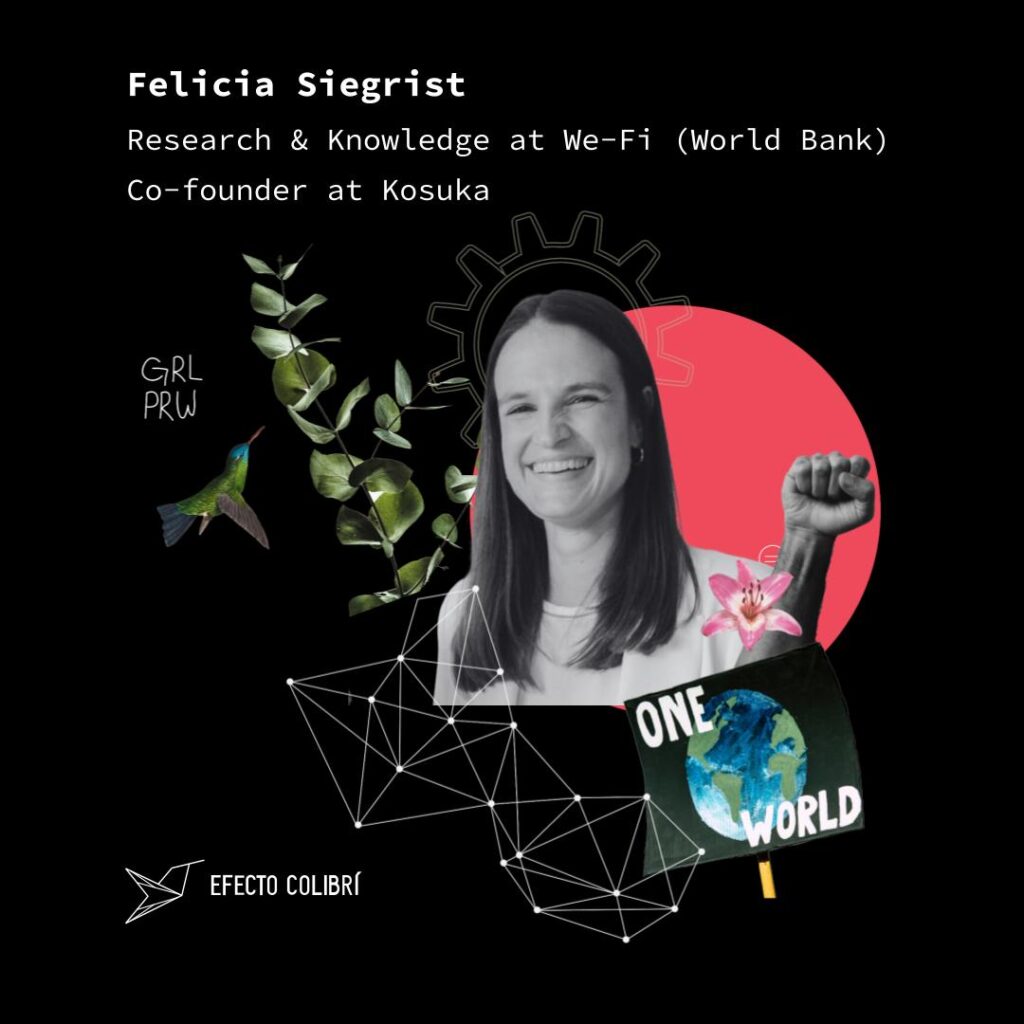
In this episode of Proyecto Co (by Efecto Colibrí), host Ana Amrein Esnaola talks with Felicia Siegrist (Research & Knowledge at We-Fi, housed in the World Bank Group) and Co-Founder of Kusuka. Together they explore what it really takes for women entrepreneurs to start, lead, and thrive—across legal systems, social norms, access to finance, and the data (and bias) shaping investment decisions.
Women entrepreneurs are driving growth and job creation—but structural barriers still limit what’s possible: unequal legal rights, the weight of unpaid care work, uneven access to finance, and persistent bias in investment ecosystems. Felicia shares lessons from her work at We-Fi (Women Entrepreneurs Finance Initiative) and from building Kusuka offering a grounded look at what works, what doesn’t, and how change actually happens (with women and men working together).
Agency + confidence matter—and so do the systems that shape them.
Legal equality isn’t the finish line: discrimination can persist in finance, networks, and markets even when laws improve.
Unpaid care work is a major growth constraint—time poverty is economic policy.
Data is power: without sex-disaggregated data, institutions can’t manage what they don’t measure.
Investment bias is real—and representation in decision-making teams changes outcomes.
[00:02:20] Why entrepreneurship can feel like “agency”—and why that feeling isn’t equally available to all
[00:05:40] Kusuka’s origin story: Kenya (2020), COVID, and learning by iterating
[00:07:40] Pivoting from B2C to B2B and the reality of searching for product–market fit
[00:09:20] The legal barriers women face in many countries—and why this still matters
[00:10:10] “Only 14 economies” with full legal equality across areas measured (WBL)
[00:12:10] Social norms + unpaid care work as structural barriers
[00:20:50] The data gap: why institutions often don’t know how much of their portfolio is women-led
[00:23:10] Venture capital bias and the tiny share going to all-women founding teams
We use cookies to improve your experience and offer you personalized content. By accepting, you help us provide you with a better service.

únete a nuestro newsletter
Dedica solo 5 minutos para contarnos cómo te impacta nuestro contenido.
Ana: Hello and welcome. I’m Ana Amrein Esnaola.
Today you’re listening to Proyecto Co, the podcast by Efecto Colibrí. (Además,) this channel is inspired by words that start with co: community, consciousness, co-creation, and co-evolution.
In Spanish, colibrí means hummingbird. (Por ejemplo,) it reminds us that small actions can create meaningful change.
Here, we have honest conversations with change makers. (Por eso,) we explore mindsets and initiatives for positive change.
Stories can shift how we see ourselves and others. (Sin embargo,) stories can also regenerate our sense of possibility.
That is why, at Efecto Colibrí, we create and share podcast content. (En consecuencia,) our goal is to inspire a more just, equitable, and regenerative reality for all.
Discover more at www.efectocolibri.com.
My guest today is Felicia Sigrist. She works in Research & Knowledge at the Women Entrepreneurs Finance Initiative (We-Fi), housed in the World Bank Group. (Además,) she is the Co-Founder of Kusuka.
At We-Fi, Felicia helps shape research and strategies to expand women entrepreneurs’ access to finance and opportunity across 82 countries. (Por lo tanto,) her work connects evidence with action.
With Kusuka, she is building a women-led brand that brings unique handmade design pieces to the world. (Asimismo,) the brand champions sustainable consumption and supports women artisans.
Ultimately, one clear through line connects everything: unlocking women’s power to create, lead, and thrive. (Finalmente,) let’s begin.
Ana: Felicia, welcome to Proyecto Co. It’s a pleasure to have you here.
Felicia: Thank you so much. It’s a real pleasure to be here. Thank you for inviting me. It’s an honor.
Ana: You are a woman and an entrepreneur. You also work with women entrepreneurs around the world.
Why is it special to be a woman entrepreneur? And why is it important to support women entrepreneurs?
Felicia: It feels great. It feels like you can change things in this world.
You have agency. You have the confidence to build something.
At the same time, I know I’m privileged to feel this way. (Sin embargo,) many women do not feel that empowered.
Also, Ana, you are a woman entrepreneur too. (Además,) you may recognize that feeling.
Still, women around the world may not feel free to act on their own. (Por ejemplo,) they may not feel able to unleash their entrepreneurial creativity.
Entrepreneurship is close to my heart. (Por eso,) it connects two things I care about: gender equality and entrepreneurship.
Because of that, I believe empowering women can create real change.
Ana: I agree. And I think it matters to name our privilege.
We are white. We come from the Global North. (Además,) in my case, my parents supported me to go to university.
So there are many layers of privilege. (Por lo tanto,) we should acknowledge them.
At the same time, being a woman still comes with barriers.
Felicia: Definitely. Even as a privileged woman entrepreneur, I doubt myself sometimes.
I go through phases where I’m not confident.
Ana: Does that happen to you too? Do you struggle sometimes?
Felicia: Yes, definitely. And I think many women experience this. (Por ejemplo,) we may doubt ourselves more than men do.
Often, we wonder if we are on the right path. (En cambio,) men may feel more entitled to take space.
As a social entrepreneur, I promote African women artisans.
I work with artisans in Kenya, Ghana, and Senegal. (Además,) many of them are entrepreneurs too.
They build businesses from their art and craftsmanship. (Por eso,) I support women on the ground, in real life.
At the same time, I also look at the bigger picture. (Asimismo,) I try to understand policies, regulations, and constraints.
Ana: I love the pieces you’ve brought together. They’re incredible.
Felicia: They’re so beautiful, right?
Ana: How did it start?
Felicia: I started Kusuka with a friend when we lived in Kenya in 2020.
It was during COVID. (Sin embargo,) we decided to build anyway.
We connected through shared passions: entrepreneurship, women’s economic empowerment, and design.
We were fascinated by Kenyan baskets. (Por eso,) we spoke with artisans.
They explained the challenges of selling their baskets. (Por ejemplo,) COVID made it even harder.
That’s when we understood the local reality: selling art and craftsmanship can be difficult.
So we built an e-commerce shop to sell the baskets in Europe. (Por lo tanto,) the idea was to connect artisans with new markets.
We believed people would love them. (En consecuencia,) that’s how we started.
Since then, we changed our business and impact model several times.
We made many mistakes. (Sin embargo,) we learned a lot.
So it has been a great journey, but also a long one.
Ana: Incredible. So it started as a marketplace. What is it now?
Felicia: We ask ourselves that question all the time.
We moved from B2C to B2B. (Además,) we collaborate with concept stores, department stores, museums, and galleries.
We showcase art based on traditional weaving techniques. (Asimismo,) we feature contemporary designs made by women artisans.
It is not a marketplace anymore. (En cambio,) it is closer to a curated brand and platform.
Right now, we are still evolving. (Por eso,) we are rethinking the model again.
We are still looking for product–market fit.
Ana: It takes time. It’s constant evolution.
Ana: Why do you care so much about gender equality and entrepreneurship?
And what can you tell us about the situation for women entrepreneurs today?
Felicia: I’m happy to share more about my work at the World Bank Group with We-Fi.
We-Fi stands for the Women Entrepreneurs Finance Initiative. (Además,) we work at a global level in emerging markets.
We support women in starting and growing businesses.
We have projects in more than 80 countries worldwide.
In many places, women do not have the same rights as men to start a business.
Sometimes women cannot travel freely. (Por ejemplo,) they may not be able to sign contracts or open bank accounts.
And in some contexts, women cannot apply for a loan without a husband’s signature.
Only 14 economies provide women equal legal rights to men across areas measured. (Sin embargo,) these are high-income economies.
Ana: Which ones?
Felicia: Belgium, Canada, Denmark, France, Germany, Greece, Iceland, Ireland, Latvia, Luxembourg, the Netherlands, Portugal, Spain, and Sweden.
Ana: Not even the U.S.? Not Switzerland?
Felicia: No.
Ana: How did we get here? Are countries moving forward?
Felicia: The statistic comes from Women, Business and the Law, a World Bank Group report.
Each year, it measures legal and regulatory constraints affecting women across countries. (Por eso,) it helps track progress.
There has been progress. (Sin embargo,) there is still a lot to do.
And the number is disheartening.
Legal barriers are one part. Social norms are another. (Además,) norms can be harder to shift.
In many places, society expects women to stay home and care for family.
Unpaid care work is a major barrier for women entrepreneurs. (Por ejemplo,) it includes childcare and elder care.
Women often spend much more time than men on care work. (En consecuencia,) they have less time for the business.
This imbalance also adds stress. (Por lo tanto,) it can affect business performance.
Many women start businesses at home to balance work and family. (Sin embargo,) that can reduce visibility and networking.
Felicia: All of this affects access to resources, including finance.
Access to finance is a major focus for We-Fi. (Además,) it is often the biggest constraint.
In many countries, women cannot own or inherit assets. (Por lo tanto,) they lack collateral for loans.
Even when women get approved, they may receive smaller loans. (Asimismo,) they may face higher interest rates.
Bias can influence how risk is perceived. (Sin embargo,) that bias is not always visible to institutions.
And finance is not the only issue. Women may also have less access to training, markets, networks, and digital technologies.
Ana: Do women living under these social norms want to break through and become entrepreneurs?
Felicia: I think role models matter because they show what’s possible. (Por ejemplo,) seeing someone like you can expand your options.
But social norms change slowly. (Por eso,) change must be led by the people directly impacted.
In many contexts, women’s entrepreneurship rates are high. (Sin embargo,) many women operate in the informal sector.
They want to grow. Structural barriers hold them back.
Another key point is men’s engagement. (Además,) men allies can help shift norms.
In some programs, women can invite spouses or family members to trainings. (En consecuencia,) the training can be more effective later on.
Ana: That applies in Switzerland and Spain too.
Felicia: Exactly. Men and women are both needed to lead change.
Ana: Do many women bring their spouse to your programs?
Felicia: It’s not a general trend. (Sin embargo,) some programs are designed that way.
Those programs often focus on social norms. (Además,) they can support women entering male-dominated sectors.
Many women work in lower-profit industries. (Por eso,) it is important to bring more women into manufacturing and climate-related sectors.
We also need more women in high-growth entrepreneurship in tech and finance. (En consecuencia,) that is where jobs and growth can accelerate.
Ana: What kind of programs do you run?
Felicia: We work across the whole ecosystem.
We focus on finance, skills, markets, and the enabling environment. (Por ejemplo,) we address legal and regulatory constraints.
We work with governments on policy reforms.
We also work with more than 300 local organizations on the ground. (Además,) partners help us reach entrepreneurs directly.
These programs help women access financing and training. (Asimismo,) they help women reach markets through procurement, value chains, and digital platforms.
We also work with financial intermediaries like banks and venture capital funds. (Por lo tanto,) we try to change how institutions operate.
A major issue is the lack of sex-disaggregated data.
Many banks do not track how much of their portfolio is women-led. (En consecuencia,) they cannot manage what they do not measure.
That’s why we launched the WE Finance Code. (Por eso,) we promote better data collection and better use of data.
We also need more gender-balanced investment teams. (Además,) representation influences decisions.
The same is true in banks: more women in leadership can change outcomes.
Systemic change requires many actors working together. (Finalmente,) that is how we remove structural barriers and build inclusive systems.
Ana: What are the biggest barriers to systemic change?
Felicia: Deep-rooted gender bias and stereotypes.
Venture capital is still very male-dominated. (Además,) women are often seen as riskier.
Only around 3% of global venture capital goes to all-women founded companies. (Sin embargo,) that number should be much higher.
Ana: That’s nothing.
Felicia: Exactly. Decision-makers are still often men. (Por lo tanto,) people tend to invest in what feels familiar.
Ana: If laws are in place—like in Sweden—does equality actually happen?
Felicia: Legal equality helps. It makes it easier to start a business. (Sin embargo,) discrimination can still appear in finance, markets, and networks.
You may still face bias when applying for a loan. (Asimismo,) you may face bias when pitching to investors.
Ana: And sometimes we are hard on ourselves too. Perfectionism. Imposter syndrome.
Felicia: That relates to my own experience.
Many women feel they must work harder to be taken seriously. (Por ejemplo,) we are often underestimated.
This pressure can be exhausting. (En consecuencia,) perfectionism can become a survival strategy.
I experienced gender bias early on when I played soccer.
For years, I was the only girl on the team. (Por eso,) I felt I had to prove I belonged.
I also worked for many years as a flight attendant. (Además,) it is a field with strong stereotypes.
Physical appearance can affect how performance is judged. (Sin embargo,) that is rarely acknowledged openly.
There is also a large pay gap between pilots and cabin crew.
These dynamics shaped how I see equality and opportunity. (Por lo tanto,) they shaped my values.
Women face pressures that men often don’t experience. (En consecuencia,) these messages can affect self-worth.
They can influence career choices, entrepreneurship, and speaking up.
Ana: Many people in our community are women entrepreneurs.
Is there a quote you’d like to share with them?
Felicia: I read something yesterday that stayed with me:
“We often think we need to find our purpose in life. But purpose is built, not found.”
It’s about agency. It’s about building. (Sin embargo,) it’s also about community.
Yes, challenges exist. (Además,) there are many inspiring women out there.
There are real opportunities to grow and create unique paths. (Por eso,) the world needs women’s leadership.
Let’s do it together.
Ana: Thank you, Felicia.
Take just 5 minutes to tell us how our content impacts you.
Sign up to our newsletter