
Op-ed by Chus Álvarez, Membership and Leadership Development, Women in Migration Network
Climate change is not an issue, it is the context we are working in. Colette Pichon from Taproot Earth shot that clip in the first lecture of the eight-week International School on Climate Mobilities (ISCM), organized by the Beyond Climate Collaborative.
Thinking about climate breakdown as the context, rather than as a separate issue, pushes us to consider how it impacts every aspect of our lives. Rising temperatures are melting ice, raising sea levels, and increasing the intensity of natural disasters and their consequences, which in turn are shaping people’s lives. It is too hot to work and people are too poor to rest; droughts and floods threaten access to water, food security, and human health; homes, lands, and livelihoods are repeatedly lost.
Mobility[1] within this context is not linear or binary: many are internally displaced without any safety or certainty; others are pushed beyond international borders. Some reclaim their right to stay while others have no means to move. Many wish to return and some are able to do so, but only to emptied places where they will start over and over again.
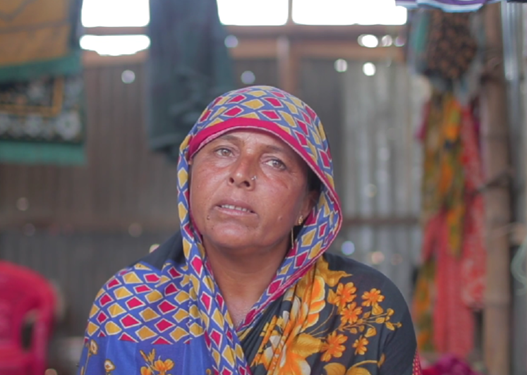
Asma Begum lives on a river island in Chandpur, Bangladesh amid repeated displacements. From Loss, longing and rivers – songs of Bangladesh by Dialogue Earth.
There are more than 120 million displaced persons across the world primarily due to violence, conflict and climate change. —Most of them internally or to neighboring countries, not to the enriched[2] nations building the physical and non-physical walls.— In a context of climate crisis it means that all displaced persons are affected by its consequences. Take the ongoing conflict in Sudan with over 11 million displaced persons. 900,000 of which are located in Chad, one of the most vulnerable countries in the world to climate change. Heavy rains and flooding routinely destroy shelters and basic infrastructure and contaminate fresh water. The impact of armed groups along the Sudan-Chad border exacerbates the already harsh living conditions
Meanwhile, migrants are being used as scapegoats; criminalized, chased, and detained in the name of security. On too many occasions brutally assaulted or killed.
Enriched nations seem to have decided to stop migration at any cost. Literally at any cost, considering that the budget for the European Union border agency, Frontex, has increased by a whopping 6000% since 2006 (roughly €19 million) up to 2026 (approximately €1.21 billion). Frontex receives more money than any other single EU agency. Did nations choose militarising their borders to approach global climate action? Well, let’s keep digging into numbers and facts.
The Military Industry as a Key Driver of Climate Breakdown
The world’s militaries are one of the top polluters on earth. The military industry accounts for around 6% of global greenhouse gas emissions, double that of the civil aviation sector. Yet, they face zero accountability: no country is mandated to report its military emissions. The 1997-adopted Kyoto Protocol[3] included a hidden clause that gave the most carbon-intensive activity on the planet a free pass. Industries and activities that consume the most fossil fuels were exempt from monitoring until 2015, when the clause was replaced with a voluntary requirement.
As the International Peace Bureau states, “the largest historical GHG emitters are also the biggest military spenders, a correlation that is not coincidental but rooted in the intertwined history of fossil fuel expansion and military power. Global military spending has grown by 37% in the last decade, with the top five spenders (US, China, Russia, Germany, India) showing increases ranging from 18.8% to 101.3% from 2015 to 2024. This growth is set to continue, with NATO’s recent commitment for members to spend 5% of GDP on the military potentially doubling expenditures to $19 trillion between 2025-2030 and generating an additional 840 million tonnes of emissions.”[4]
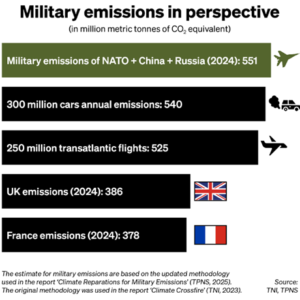
There is a destructive cycle in which militarism drives climate change, and climate change increases instability and therefore, mobility which is addressed by militarised borders.
Climate Collateral. Military emissions in perspective. TNI, TPNS
There is a destructive cycle in which militarism drives climate change, and climate change increases instability and therefore, mobility which is addressed by militarised borders. In parallel, enriched nations are exporting weapons to the world’s 40 most climate-vulnerable countries. Remember Sudan? The conflict, the impact of the climate crisis and the 11 million displaced people mentioned above? Well, hold that thought while you read that Sudan is the 4th most vulnerable on that list.
War and conflict fuel climate breakdown and derail global sustainability efforts. It seems quite obvious that the cycle must be broken: militaries must commit to emissions reporting and reduction under climate treaties and governments must reallocate military budgets and fund climate action. Easy peasy! Or not?
Military Spending vs. Climate Action
While climate finance falls short, military spending soars. The Climate Collateral (2025 update) affirms that “in 2024, global military expenditure surpassed $2.7 trillion, a sum that fuels significant greenhouse gas emissions, drains essential resources from climate initiatives, and escalates the geopolitical tensions that hinder multilateral climate cooperation. A mere 5% reallocation of this military spending would yield $135 billion—more than enough to meet the long-overdue $100 billion global climate finance target.”
While climate finance falls short, military spending soars.
Official climate finance accounting has theoretically risen according to the OECD, with wealthy nations collectively mobilizing $136.7 billion in 2024. However, Oxfam International contests this number and calculates the “true value” to be closer to around $36 billion. They also stated that up to 65% of the climate finance was delivered as loans at market rates and that only approximately $17 billion was allocated to adaptation.
At the same time, hard cash allocations for domestic border walls, surveillance technology, and militarized deportation infrastructure have outpaced real climate action. Top greenhouse gas emitters spent 2.3 times more on border enforcement (more than $33.1 billion) than on climate finances ($14.4 billion) between 2013 and 2018.[5]
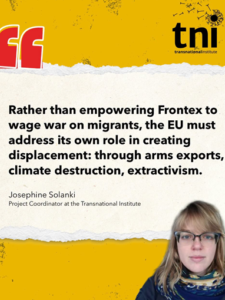
The Left. Billions for EU’s ICE
Let’s set things straight: enriched nations and the global elite plunder the world of resources in order to accumulate wealth; their militaries drive greenhouse gas emissions by primarily burning fossil fuels; and then nations choose to insulate themselves from the impacts of the climate crisis by militarising their borders. Already flabbergasted? Well, let me share one last fact.
The border and surveillance industry is making a lot of money with this militarisation. Mark Akkerman states that “the global border security industry was worth an estimated $48 billion in 2022 and is projected to reach $81 billion by 2030[6]” with key players from Europe, Israel and the US.
Challenging the Status Quo
Bringing about change demands implementing policies that tackle not only the effects of the climate crisis, but also the causes of these global inequities without causing further harm. In other words, it calls for climate justice.
Climate breakdown is upon us —recurring wildfires; heat waves; disappearing islands; intermittent floods and droughts— and concerns us all. However, it does not affect everyone equally because of global inequities, which mean that those who have contributed least to causing the crisis are the first to suffer its consequences and those who suffer the most. Bringing about change demands implementing policies that tackle not only the effects of the climate crisis, but also the causes of these global inequities without causing further harm. In other words, it calls for climate justice.
Unfortunately, most nations are choosing militarisation over justice to approach global climate action. Those who move as a result of the climate crisis and the consequent lack of livelihood are confronted with impossible pathways and militarised borders. But don’t despair; if we believe in participative democracy, we still have a say.
For governments to move resources away from pensions, health, and education systems to arms and surveillance companies, they need our consensus, the working classes. A consensus that is built with racism at its core: the narrative against migrants. Challenging that consensus offers a great opportunity to turn the situation upside down.
Well, here is my ask: Don’t buy into a narrative that first states there is an “other” and then pits one against these others. Keep smart. Find out who profits. How else and better could we use the money invested in militarisation? Ask questions. Lobby your government to ensure safety and dignity for people on the move instead of propping up the border and surveillance industry. Be an active part of implementing just solutions.
[1] The author chose to use the term mobility over displacement or migration as a way to include the myriad of situations and highlight, precisely, that those movements (or lack of) are not linear or binary. Often different situations coexist in complex ecosystems.
[2] The author chose to use the term “enriched” nations as a way to make it visible that for these nations to become rich there is an active relationship of impoverishing other nations.
[3] The Kyoto Protocol is an international climate agreement adopted in 1997 in Kyoto, Japan, under the United Nations Framework Convention on Climate Change (UNFCCC). Its goal is to reduce carbon emissions by setting legally binding targets for industrialised countries, reflecting their greater historical responsibility for climate change.
[4] Climate Collateral (2025 update): Why the military’s impact on climate change can no longer be ignored by The International Peace Bureau. https://ipb.org/climate-collateral-2025-update-why-the-militarys-impact-on-climate-change-can-no-longer-be-ignored/
[5] Global Climate Wall. How the world’s wealthiest nations prioritise borders over climate action by Todd Miller with Nick Buxton and Mark Akkerman. 2021. Transnational Institute. https://www.tni.org/en/publication/global-climate-wall
[6] Global Spending on Immigration Enforcement Is Higher than Ever and Rising by Mark Akkerman. Migration Policy Institute. https://www.migrationpolicy.org/journal/feature/global-spending-immigration-enforcement-higher-ever-and-rising
Chus Álvarez is the Membership and Leadership Development Lead at the Women in Migration Network (WIMN). She is a passionate feminist, an avid reader, and a sea lover. She leads the development of WIMN’s leadership program with grassroots organizations, as well as its language justice initiatives and climate change advocacy.
This article is part of a series developed through the collaboration between the Women in Migration Network (WIMN) and Efecto Colibrí.